Saturday, February 26, 2011

Monica Roccaforte Collection

black holes in the early universe.

There is a growing view that black holes in the early universe may have been the seed around which most large galaxies today (now with a supermassive black hole at their centers ) began to grow. And taking a step back, could also be the case that black holes were the key to reionization of the early interstellar medium - which in turn influenced the large-scale structure of universe today.

To recap the first years ... First came the Big Bang - and for about three minutes it was very compact and therefore very hot - but after three minutes the first protons and electrons formed and the next 17 minutes a proportion of these protons interacted to form helium nuclei - up to 20 minutes after the Big Bang, the expanding universe became too cold to keep the nucleosynthesis . From there, protons, helium nuclei and electrons only ranged over the next 380 thousand years as a very hot plasma.
There were too many photons, but there was little chance that these photons do something other than form and immediately be reabsorbed by a neighboring particle in the hot plasma. But the 380,000 years, the expanding universe cooled enough for protons and helium nuclei combine with electrons to form the first atoms - and suddenly the photons were left with empty space were issued as the first rays of light - which in this day is still possible to detect as CMB .
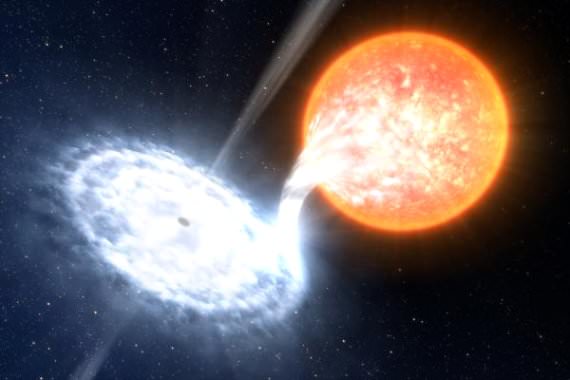

high-mass binary (with a black hole as one of its components) emit X-rays were probably common in the early universe influencing their subsequent fate being a possible cause of the reionization process that ended the so-called dark age of universo.Credito: ESO.
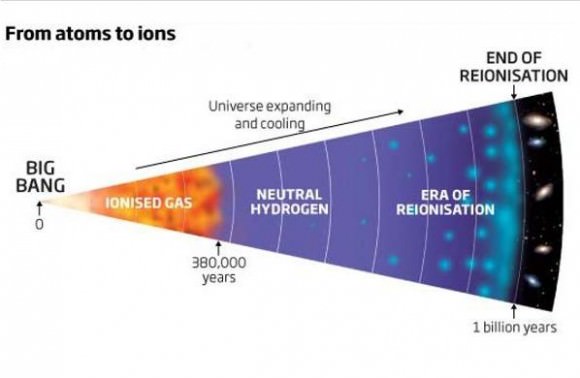

diagram showing the stages through which has passed the state of baryonic matter from the beginning of the universe (where there ionized plasma) after neutral atoms formed (380,000 years after the bigbang) and then re-reionize (500000 years after big bang) when the first stars formed, this plasma reionised that filled the interstellar medium was completely transparent to radiation and siéndolo.Credito continues: New Scientist.

What followed was the so-called dark ages only to about half a billion years after the Big Bang, the first stars began to form. It is likely that these stars were big, very big, as fresh and stable atoms of hydrogen (and helium) available were added and widened. Some of these first stars may have been so great that quickly blew apart as a supernova unstable pair. Others were simply too big and collapsed into black holes - many of them having too much gravity (itself) to allow a supernova explosion could fly any material from the star.
And here is where the history of reionization begins. Cold atoms and hydrogen stable early interstellar medium not remain cold and stable for long. In a smaller universe full of dense massive stars, these atoms quickly overheated, causing their electrons and nuclei are dissociated into ions became free again. This created a low-density plasma - still very hot, but too diffuse to be opaque to light any longer.
is likely that this step reionization then limited the size at which new stars may grow - and limited opportunities for new galaxies to grow - (as hot and excited ions are less prone to aggregate and enhance the cold and stable atoms .) Reionization may have contributed to the current distribution "lumpy" of matter - which is generally organized in large, discrete galaxies, instead of a uniform dispersion of stars everywhere.
And it has been suggested that the first black holes - in fact the high-mass black holes X-ray binaries - may have made a significant contribution to the reionization of the early universe. Computer models suggest that in the early universe, with a trend toward very massive stars would be much more likely to have black holes and stellar remnants, rather than neutron stars or white dwarfs . Also, those black holes would be more frequently isolated binary (because the most massive stars are most multiple systems often than they do the small stars).
Thus, with a massive binary in which one component is a black hole - black hole quickly start to accumulate a large accretion disk composed of matter from another star. Then the accretion disk will begin issuing high-energy photons in particular in the energy levels of X-rays.
Although the number of ionizing photons emitted by an accreting black hole is probably similar to its parent star bright and shining, is expected to issue a much higher proportion of high-energy photons from X-ray - with each of these warming potential ionizing photons and multiple atoms in its path, while a photon of a bright star just might reionize one or two atoms at most.


source of information:


http://www.universetoday.com/83239/astronomy-without-a-telescope-black-holes-the-early-years/

Proposal For Tv Production

La Palma TV broadcast next Tuesday at the reporting 22'30h Alfaro brothers

Are there many that I have asked for the report that we recorded for the program "Dreams of Nervion of Sevilla FC TV, on Alfaro brothers. Well, this interview will be aired next Tuesday at 22'30h in the sports program La Palma Television.


During the broadcast, and Jesus Alejandro Alfaro talk about their first steps, sporting history, their present moments in their respective teams ... Also, the older brother of the flagship football home La Palma, Juanito Alfaro (CD player San Roque de Lepe ) gives us all a lesson in poise and how to advise all future stars who struggle to find the dream of being a footballer.


Yes sir, a family to follow.

Friday, February 25, 2011

Making A Congratulatory Speech

the murmur of a monster.

The Andromeda galaxy is the nearest big galaxy to our Milky Way. Like the Milky Way has a spiral arm structure with a massive black hole at its core. Unlike Milky Way, however, the black hole is remarkable in size - about 30 times larger than our galaxy, or about a hundred million times the mass solares.También is strangely very passive: the supermassive black holes Similar distant galaxies are often surrounded by accretion disks that emit bright X-rays and generate powerful jets of particles cargadas.Andrómeda lacks both. Astronomers want to understand why the heart of Andromeda is so still, so to model the behavior of black hole, as well as trying to understand why they are so distant galactic nuclei different, astronomers also made the question of whether the Milky Way once went through a similar phase?


composite image of the Andromeda galaxy in infrared (red) and X-rays (blue). A new study by X-ray emission from the region around the supermassive black hole at the galaxy's core activity is of bursts, is the first time that such processes (similar to the Milky Way) have been observed anywhere else other than our galaxia.Credito: Herschel ESA's XMM-Newton.

The black hole of the Milky Way is also at rest compared with that of other galaxies, but it is curious that erupts from time to time in X-rays, infrared and radio wavelengths, sometimes increasing their brightness by a factor of ten or a hundred a short time. It was thought that perhaps the black hole environment of the Milky Way was different in a special way, perhaps in some way related to the greater questions about the ultimate issue remote systems. Astronomers CfA
Zhiyuan Li, Michael Garcia, Bill Forman, Christine Jones, Ralph Kraft, Dharam Val and Steve Murray, carefully analyzed a decade of X-ray observations made by the Chandra Observatory of the Andromeda galaxy , resulting notable.Encontraron that although the core was passive from 1999 to 2005 in 2006 increased its X-ray luminosity by forty times, and remains bright and variable today. The team proposes to do in future studies coordinated X-ray and radio. The results are important to show that the black hole of the Milky Way is not the only (at least in regard to outbreaks), and provides a step towards a better understanding of what happens in other galactic nuclei with holes black.


read the study HERE


source of information:


http://www.cfa.harvard.edu/news/2011/su201108.html

Thursday, February 24, 2011

Cake Ideas For A Mother's Birthday

signs of a strange particle decay.

According to the standard model of particle physics, matter is composed of three "families" quarks and leptons .

Each family has four types of particles: two quarks and two leptons. Ordinary matter consists mainly of particles of the first family: up and down quarks, which are tightly bound inside protons and neutrons, the electrons and electron neutrinos, which are abundantly produced by fusion reactions inside stars. For all we know, quarks and leptons of the second and third family are identical copies of the first family, but have heavier masses. These heavy quarks and charged leptons are unstable particles that can be produced in high energy collisions, but extremely fast decay through the weak interaction , particles of the first family.
This description of the matter is consistent with experiments that have been observed, but why do we have three almost identical replica of the quarks and leptons (also known as the three "flavors" of quarks and leptons), but with different masses, is one of the great open questions in particle physics. In the limit of no electroweak symmetry breaking, any standard model particles should have a mass. The problem of the masses of quarks and leptons, therefore, is intimately connected with the other major open question in particle physics: why carriers of the weak force the W and Z bosons-have mass? In the standard model , these two problems are solved by what is called the mechanism Higgs : quarks and leptons, as well as W and Z bosons have mass because they interact with a new field, called the Higgs field. In this table, is the Higgs field who electroweak symmetry breaking . If high-energy experiments at the Large Hadron Collider (LHC ) at CERN could detect a Higgs field excitation-(Higgs boson), would be proof that this mechanism is the basis of the masses existing particles.

Higgs mechanism postulated in the standard model, however, is not satisfactory for various reasons, mostly because it becomes unstable at high energies. Instead, it is likely that the idea of \u200b\u200ba Higgs field is really just a low energy approximation of a more fundamental theory. The signal from this "true" theory to higher energies appear as new degrees of freedom in the form of new heavy particles. Attempts to find evidence of this new theory can be divided into two main categories: (i) direct search for the new degrees of freedom through experiments in high energy frontier, and in particular in the LHC, and (ii ) indirect search for new particles through precision studies at low energies, the so-called border high intensity. The latter is particularly relevant in determining the structure of taste of new degrees of freedom, or how these new fields are coupled to different families of quarks and leptons. It is in this context that Joachim Brod, Gorbahn Martin, and Emmanuel Stamou Technical University of Munich, Germany, have developed a better theoretical description of a rare particle decay to give experimenters a powerful tool to look for signs a more fundamental theory. Their calculations, specifically details the probability of a K meson (kaon) decays into a pion (π ) neutrino (ν ) and antineutrino (ν -) ( K → π ν ν -) (see Fig), are presented in the journal Physical Review D.
Assuming that the image is correct, the presence of the Higgs field mixes different families of quarks in the weak interaction and establishes a hierarchy in the various modes of decay of heavy quarks in the lightest. In particular, the interaction between the Higgs and weak interactions implies that the processes where a quark changes flavor, but not its cargo (for example, the strange quark is a second family becomes the bottom of the quark first family, which has a different mass but the same electrical charge) can occur only in higher orders of electroweak interactions and are strongly suppressed. These processes, called transitions changing neutral current flavor ( FCNC) are an ideal place to search for new physics: the signal (of the new physics) excel in the narrow context of what already predicted by the standard model.


up the image the disintegration of K → π ν ν is mediated by the transition from neutral current flavor changing s d → ν ν (where syd reprentaciones the strange quark and down respectively). Below is a diagrammatic representation of a loop contribution the extent of s → d ν ν within the standard model on the left and within a standard model extension to the right. Credit: Alan Stonebraker.


decay K → π ν ν -on study by Joachim Brod is a particularly interesting example of FCNC transitions: the likelihood that these processes occur ( call branching ratios ) can be calculated to an exceptionally high degree of precision, not compared to any other FCNC process involving quarks. The exceptionally clean theoretical decay K → π ν ν - in the standard model is a very simple: the probability of decay is dominated by the exchange of heavier particles the standard model (the top quark and W and Z bosons) and these contributions can be calculated reliably in perturbation theory . Since the early nineties, theorists began to make these calculations more and more accurate [more here, here and here ]. Joachim Brod further strengthens the theoretical cleanliness of these modes with a full evaluation of the two-loop electroweak contributions (ie, including contributions to the sixth order in the coupling constant weak.) As was discussed in the present study irreducible theoretical error of the ratios are at 4% and 3% for the modes ( + K Π → + ν ν -) and ( K L → π 0 ν ν -) respectively.
There is a price to pay for this high theoretical cleaning. The ratios are small, for every ten billion K-mesons, only one, on average, should decline in the final state π ν ν - and the experimental signature (two neutrino states end) is difficult detect because they are very weak interacting neutrinos. This is the reason why the experimental search for these processes is a very difficult task. So far, only a few events ( + K → π + ν ν - ) have been observed by the E787 experiment [see here] and E949 [see here ] the Brookhaven National Laboratory . Their combined data lead to a decay rate of which is compatible with the standard model, but has an error too large to provide a very stringent test of the model. In other words, the theory is more accurate than the experimenters are now able to measure. The good news is that new pilot programs to substantially improve the measurement accuracy of these rare decays have been or are being discussed in several laboratories: the experiment NA62 at CERN aims to collect about 50 events + K → π + ν ν - per year, with 20% of fund from 2012. In a similar time scale, the experiment KOTO in J-PARC aims to collect some events as neutral, assuming the standard model is correct. On a longer timescale, experiments related kaon plan Project-X at Fermilab may be able to reach a level of accuracy of a few percentage points in the two decay modes. Thanks to the great cleansing theoretical amplitudes K → π ν ν - , these future experiments will provide valuable information on the flavor structure of physics beyond the standard model.


read the study HERE


source of information:


http://physics.aps.org/articles/v4/15