Thursday, February 24, 2011

White Vaque Sundowners

The football ; One weekend a few games

Bridge Building Andalusia Day will be held on provincial championship teams, making it necessary to stop the league in several categories. As an example, the child Andalusian cadets.


So, will only eight the parties be played this weekend.

I let you the dates and times :

PLAY AT HOME

Saturday February 26

• 10'45h . Child 2 nd Prov G2, S. happy - CD San \u200b\u200bJuan

• 12'30h . 1 st Provincial Benjamin, S. happy - R. Pancho

• 12'30h . Benjamin 2 nd Prov G2, S. happy - Santa Marta

• 16'00h . Amateur 1 ª Andaluza La Palma CF - CF
Olont
Sunday February 27

• 12'00h . Youth D. Honor, S. happy - UD Almería

NOT PLAY

Friday February 25

• 17'00h . Alevín 1 st Provincial, Huelva RCR - S. happy

Saturday February 26

• 10'30h . 2 nd Pr Alevín G3, Atco. Columbus - S. happy

• 11'30h . 2 nd Pr Alevín G2, Trigueros - S. happy


luck everyone!

Tuesday, February 22, 2011

Navy Blue& Brown Curtains

core of neutron stars behave like a superfluid.

The neutron stars, the compact remnants of some supernova explosions are some of the most mysterious objects in the universe.

These peculiar objects have a mass between one and two times the Sun, but are packaged in a space of only 20 km in diameter (70, 000 times smaller than the diameter of the sun). The average density of a neutron star can therefore exceed a few hundreds of billions of grams per cubic centimeter, a density several times found within the heavier atomic nuclei. The extreme conditions that prevail in the interior of neutron stars are so far from those found in laboratory experiments that the properties of their nuclei remain largely unknown, and the theoretical description of matter the neutron star is currently one of the most challenging issues of nuclear and particle physics. In an article appearing in the journal Physical Review Letters, Dany Page of the National Autonomous University of Mexico and his colleagues in the U.S., argue that there is strong evidence that the neutrons in the nuclei of neutron stars form a superfluid. This conclusion, which was reached independently by another group led by Dima Yakovlev Technical Physics Institute in St. Petersburg, Russia, is based on recent observations of X-ray thermal emission from the young neutron star in Cassiopeia A which is the remnant of a supernova (see Fig).
From the chance discovery of pulsars radio Jocelyn Bell Burnell and Anthony Hewish in 1967, nearly two thousand neutron stars have been detected. Many more probably exist in our galaxy. As was predicted by William Baade and Fritz Zwicky in 1933, neutron stars are born of the catastrophic gravitational collapse of the iron core of massive stars at the end point of its evolution. During the first ten seconds after the explosion of the supernova, the newly formed protoneutrón star has a radius of 50 km and remains very hot, with temperatures internal order of a few billion degrees. About a minute later, the star becomes transparent protoneutrón the nearly massless particles called neutrinos produced abundantly in the interior. This allows easy and escaping neutrinos carry energy, so the protoneutrón star cools rapidly and shrinks in an ordinary neutron star. When the temperature falls below a billion degrees, the outer layers of the star crystallizes into a solid crust. At this point, the nucleus is much colder than the crust due to cooling energy produced by the neutrinos escape. After several decades, the interior of the star reaches a uniform temperature of hundreds of millions of degrees (except for a thin outer shell covering of heat). The last stage of cooling is carried out after a few hundred thousand years, when heat radiates from the interior to the surface and is dissipated as thermal electromagnetic radiation [more here and here ].


Cassiopeia A in the constellation of Cassiopeia is the youngest neutron star conocida.Basados \u200b\u200bin the cooling rate observed the star, astrophysicists believe that the neutrons in their nuclei are in a superfluid state. The upper part shows an image of Cassiopeia A in Xray at the bottom is an illustration showing the different layers of a neutron star. Credit: (Top) NASA / Chandra X-ray Observatory, (Bottom) redrawn with permission from Fridolin Weber, San Diego State University.

The metal surface, which is composed mainly of iron, often is hampered by a thin atmosphere. A few meters below the surface, the material is so compressed that atomic nuclei, which are arranged in a regular lattice Coulomb, are fully ionized and therefore live with a quantum gas electrones.En depths of the star, the nuclei become increasingly neutron-rich until the neutrons start to come out of the nucleus, forming an underground ocean of neutrons. Whereas the composition of the outer bark is almost completely determined by the experimental atomic masses, the inner bark, where neutrons are not bound, has no equivalent on Earth and therefore can only be studied theoretically. The crust is dissolved in a uniform liquid of neutrons, protons and electrons when the density reaches about half of which is inside the heavy nuclei. In the crust-core transition kernel can take very unusual ways, such as rods or plates that are called "pasta" nuclear and could be responsible for half the mass of the crust. The composition and properties of dense matter in the inner core of a neutron star are still poorly understood
In particular, it was suggested in 1959, before the actual observations of the first pulsars, the interior of neutron stars could contain a neutron superfluid-a frictionless liquid with very unusual properties. Superfluidity is one of the more macroscopic showy quantum mechanics. The nucleons are fermions , and due to Pauli exclusion principle generally tend to avoid themselves. This individualistic behavior of the nucleons, along with strong repulsive nucleon-nucleon interaction at short range, provided the pressure needed to counteract the enormous gravitational pull of a neutron star, which prevents collapse. However, at sufficiently low temperatures, the nucleons can be paired. These couples are bosons can behave consistently in a very large scale and the nucleon condensate can flow without viscosity, analogous to the superfluidity of helium-3. (Interestingly, while helium-3 becomes a superfluid only below a few mK, superfluidity is sustainable, even at a temperature of millions of degrees in a neutron star, due to the enormous density involved .) Although nuclear pairing has been theoretically studied for several decades [see here ], the core region of a neutron star where this phenomenon might occur is still uncertain. As shown in the two groups of astrophysical observations of young cooling neutron star in Cassiopeia A might shed light on the longstanding problem.
Cassiopeia A, which takes its name from its location in the constellation Cassiopeia , is the remnant of a star that exploded 330 years ago at a distance of some 11 000 light years away. The central compact object has been recently identified as a neutron star with a carbon atmosphere and a surface temperature of about two million degrees [see here ]. The neutron star in Cassiopeia A is not only the youngest known, emitting heat in isolation in our galaxy, but also is the first neutron star that has been directly observed cooling. Ten year follow-up of this object, revealed that his temperature has dropped by about 4% since its discovery in 1999 by X-ray Observatory Chandra [see here ]. This cooling rate is much faster than expected from standard theories of neutron star cooling. According to the two teams of scientists analyzed data from the Chandra X-ray to determine the cooling rate, these observations provide strong evidence for superfluidity in the cores neutron stars. In fact, the onset of superfluidity of neutrons opens a new channel for the continuous emission of neutrinos of fractionation and formation of pairs of neutrons. This process is most effective at temperatures slightly below the critical temperature of superfluid transition, improving the cooling of the star for several decades. Based on observations of Cassiopeia A, Dany Page and his colleagues determined the critical temperature of superfluid neutron half a billion degrees and argue that the protons in the cores of neutron stars are superconductors. Yakovlev's group reached similar conclusions, but its critical temperature inferred for the neutron superfluid is a few hundreds of millions of degrees higher, since they assume different microscopic entries. This rapid cooling is expected to continue for a few decades at the same speed. If Page's interpretation is confirmed by future observations, the results put stringent constraints on microscopic theories of nuclear matter density.


read the study HERE


source of information:


http://physics.aps.org/articles/v4/14

Unlock Coby Tf Dvd1023

The Palmerin, Patri Rubio, Jesus Alfaro

On Sunday, the newspaper Seville "Sports Arena" , published in its pages an interview Palmerín and ex-player of Sevilla FC, Rubio Patri.


The interview is the section "What happened to ...? , the sports newspaper dedicated to the players who went through Betis and Sevilla few seasons ago.

I leave with the report in full. I congratulate Alejandro Sáez for their hard work.

"to kick a ball BRANDY TO SELL AND VINEGAR"

The Huelva, which today is devoted in body and soul to a family winery in La Palma del Condado, recalls his time in Nervión, where he was "misunderstood" by the coaches on duty was not given any confidence.

name Patricio Bernal Rubio may sound like Chinese for many Sevilla, with a little luck, perhaps stored in his memory the name of Blanquirroja Patri, a player who went on tiptoe for Nervión and did little very little noise, in the Ramón Sánchez Pizjuán , where it had "confidence" of the coaches on duty. The very young Huelva enjoyed success, a success that perhaps it came too soon and, although he went to his head, caused certain circumstances will come large. With 15 years , pointing his career high, enjoying a surprising projection, for one thing or another, progressively diluted over having to go to a destination desperately lacking any teams interested in him.

What do you do for a living today?

My family owns a winery here in La Palma del Condado. Luis Felipe produce brandy.

And how are you? Well

. Holding the downfall of the crisis, it is not easy. Although we sell an elitist product, we are a midsize company, we pull forward as we can. With difficulties, but here we go.

Does long-standing commitment to it?

since 2004. It was quit football in June and started here in September.

Has life changed much? The

Yeah, kicking a ball to sell brandy and vinegar ... The football did not give me to live off the income, now holds a senior commercial and devote myself fully to it and enjoy my family. It is neither better or worse, I have been professional for 15 years, I am very grateful to the football. It ended an era and began another. When you live outside football real life, you, as it were somehow a step above the rest. You earn money and not think about the difficulties that lives the rest.
I was getting the idea gradually. At first, the change is complete, you receive a high wall that is insurmountable. Everything is finished, stop having so many people watching you and you do not win much easy money, your standard of living low. The hardest thing is to assimilate the change.


Do you have something to do with football?

None. I tried to squeeze the most of my career and now I'm totally disconnected. I had my ideas clear. His family business and knew that although the income would be lower, would have a solid ground in the world of football coaching for example, would have secured every month.

"Football gave no income to live because it squandered the money or because they simply did not give to much?

I, luckily, I always found people who made me see that it was important to save money and invest in properties, so I did. Still, I can not complain either, there are colleagues who unfortunately do not have to pay the floor.

Do you maintain contact with a colleague from his time at Sevilla?

occasionally play with veterans of Seville, but increasingly, as I have four children and each time it is more difficult. For my work, like it or not, I maintain relationships with friends or acquaintances of my time as a footballer, who are helping me to position the product. Quotes, is the way I have to remain connected to football.

Do you have some kind of relationship with his former teammates in Seville?

With colleagues at that time no, but if it is true that Sevilla itself. In the Cup final, the club's gift to the media was a commemorative shirt and a flask of brandy, that product was ours. That, in part because he offered the club a quality product and was due to my past relationship with the entity football.


What are your memories of his time at Sevilla?

Although I signed four years and only played one, whether they play more or less, I have fond memories. It was a very nice where you get the objective of the promotion, which served to win some more money and others leave for other teams. He played very

Nervión little ...

Some 24 or 25 games in which, by removing four or five on the jump start that I was always alternate. I knew I was in a big team like Sevilla, so I had no other thing to accept. I had always dreamed of playing in a top team, I can only fight and I knew the coach understand: I think I was a player misunderstood by some technicians.

Does that happen in Seville?

Yes, I mean to them. A Castro Santos, first, and Marcos Alonso, who replaced him later. Do not trust me, it was only when he had a head injury or a player was with his selection. I did not have the continuity needed. I misunderstood, I had to go on loan to Badajoz and next season I went back to Seville, where he had no place. Polideportivo Ejido patch to the desperate, not finding a team and I was there two years. I spent several very nice moments. Then, I ended up retiring at Almeria.

And that aimed high youth ...

If anyone paid money for a boy and came to Atletico Madrid and he did it for me. I was 15 and the maturity of a child itself, the situation passed me, but not by me but by circumstance in itself. No one put a gun anyone to sign or pay money for me.

Did you get success too soon?

Not that I arrived early success, the ways child. Gil Jesus came to the presidency and everything he did at that moment was magnified. I just wanted to play. Then came the club, where he was Cruyff revolutionizing the quarry. Was booming and, although there were many many other teams interested, we wanted the best for me. There I spent four great years where I learned and matured a lot. Sevilla
His time was a turning point in his career, which was on "stand by"
was not always the case. I do not first team debut for Barcelona because I injured my fibula. All the time my fellow first-team debut: De la Pena, Roger, Sergi. From there I went to Bangkok, where he got 14 goals in Division 2. Some numbers that caught the attention of many teams. The Sevilla was the last, threw away the other waiting, knew of his interest.


Were you hampered his career after his stint in the Sanchez Pizjuan?

It happens to everyone, if you do not give you confidence. My life was never more than football.

Would you scored much that?

No, what influenced me were the four years in Barcelona. It was always said that football is all made up and now comes Pep Guardiola and shows that this is a lie. My time there I scored a lot. He had a philosophy. Move up in class and continue to use the same system since then.


An interview with Sports Stadium.

Monday, February 21, 2011

Monster Energy Drink Booty Shorts

a world with two suns in the sky, is it possible?.

an observed binary star G type (like the sun) from a hypothetical planet with about 0.5 degrees of angular diameter in the sky would suggest that both would be around one astronomical unit away, but you could have such a close red dwarf and a distant blue giant with the same apparent diameter, but no doubt they would look substantially different, both in color and brightness .
So if the two suns are the same size and are about the same distance, then it is likely that you are standing on a planet circumbinario (like the fictional planet Tatooine Star Wars universe) that surrounds both stars in an orbit.
circumbinaria To allow stable orbit - you must meet two conditions are either a) that the planet must be very distant from the binary stars (which essentially act as a single center of mass) or b) that the two stars are very close together - so act essentially as a single center of mass. It is unlikely that a planet could maintain a stable orbit around a binary system where it is exposed to pulses of gravitational force, created when two stars approach the planet, on a regular basis.
Anyway, if you can stand on a planet and see a set of binary suns - and a way of life based on the water, then, your planet is within the habitable zone system stars, the area where water can exist in liquid form. Given this - and its apparent size and proximity to each other, most likely, you orbiting two stars who are really close together.


hypothetical set of 2 stars with an apparent diameter equal to the sun on a planet circumbinaria with an orbit around them. Crédito.Nasa.
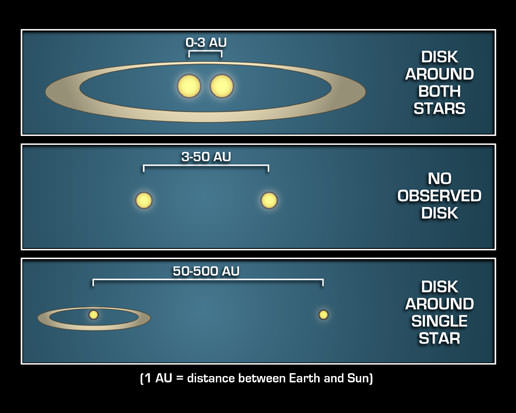

to get a planet in the habitable zone around a binary choice is probably limited to circumbinarios planets around two nearby stars or circumstellar planets around a star in a binary system widely scattered. Credit: NASA / JPL.

But, bearing in mind, that if one accepts that there are two G-type stars in the sky, then it is unlikely that the planet is exactly one astronomical unit from them - and that the presence of two stars in the sky should be equivalent approximately double the flow obtain stellar one. And it's not a simple matter of doubling the distance to reduce by half the stellar flux. Doubling the distance will reduce by half the apparent diameter of stars in the sky, but an inverse square relationship applies to its brightness and solar flux, as twice as far only get a quarter of its flow star. Therefore, something like the square root of two, ie about 1.4 astronomical units away from the stars, could be the right distance.
However, this means that the stars now need a larger diameter than the sun to create the same size were apparent in the sky - which means they should have more mass, what would a more intense spectral class. For example, Sirius has 1.7 times the diameter of the Sun, roughly double its mass - and thus about 25 times its absolute luminosity . So even at 2 astronomical units away, Sirius would be nearly five times brighter and deliver five times the stellar flux of what makes the sun to the earth (or ten times, if there are two such stars in the sky) .
So, in summary ...
is a problem to reach a stage where they could be two stars in the sky with the same apparent size, color and brightness (the sun) and keep the planet in the habitable zone - unless the planet is in orbit around circumbinaria two star equivalent. There is no reason to doubt that a planet could maintain a stable circumbinaria orbit around two stars equivalent to G type could be similar to the Sun or any other type. However, it is a struggle to arrive at a plausible scenario where these stars could maintain its angular diameter in the sky that appear to be, while keeping the planets in the habitable zone of the system.
words, if you're in a desert world, but with two stars of spectral class more intense than the G is likely to be expelled from the atmosphere of the planet - and up to two G-type stars, such a scenario would give Venus (which receives about twice the solar flux to Earth, being 28% closer to the Sun .) Could be smaller stars of the class K or M, but then they should be more red than they appear to be - and their planet would be closer to them, to the point where it is unlikely that the planet could maintain an orbit stable.